Urban Conservation
Metro and Counties Prepares to Designate Long-term Urban and Rural Reserves.
Decisions will shape regional growth for decades and determine the fate of some of the region’s critical biodiversity lands and surrounding farmland.
Should Metro expand the Urban Growth Boundary (UGB) south of the Willamette River?
Should additional urban development be allowed on the west flank of Forest Park?
Should we allow urban growth to consume ecologically rich bottomlands and high value agricultural areas in Washington County?
Or should these natural and working landscapes that powerfully define our region’s sense of place and quality of life be put off-limits to new urban development the next 40 to 50 years?
These are some of the questions the region will grapple with over the coming year as Metro and Multnomah, Clackamas, and Washington Counties embark on a planning process that will guide future expansions of the UGB and determine the shape of the region for decades to come.
Left: Subdivisions in Washington County encroach on Forest Park. Photo by C. Bruce Forester.
Background
Under a new state law passed by the 2007 Legislature, Metro and the Counties can simultaneously designate “long-term” (40 to 50 years) urban and rural reserves. Urban reserves will identify lands where Metro will expand the UGB- as currently required by state law- over the next 40 to 50 years. Rural reserves, conversely, will designate lands off-limits to UGB expansion over the same time period.
Metro and Counties must designate urban and rural reserves simultaneously and in coordination. In doing so they must consider a variety of factors. Rural reserves will be designated based largely on the quality and location of high value farm, forest, and natural areas outside the UGB that is vulnerable to future urbanization. The designation of urban reserves must consider the suitability of the land for urbanization; the ability to protect important natural landscape features such as steep slopes, floodplains, stream corridors, and wildlife habitat; and whether urbanization would displace high-value farmland and biodiversity lands.
All this is a new approach, especially in considering impacts to natural areas. For the first time the value of rural lands for fish, wildlife, clean water, and sense of place will be considered equally with commercial forestry and farming values in deciding where and when the region expands the urban growth boundary.
In the past, state law has generally required cities to avoid high-value agricultural soils first in determining which lands to urbanize. As a result, cities are often forced to expand onto the most sensitive natural resource lands. As precious as farmland is, we need a better balance. Both agricultural and natural landscapes should be treated as an integrated whole, equal parts of a holistic landscape mosaic that define our region’s economy and culture.
To inform the designation of urban and rural
reserve decisions, Metro brought together natural resource professionals and
regional experts to map the “natural landscape features” that ecologically and
culturally define the region. The inventory includes places like Willamette River, Willamette Narrows, the Sandy
River Gorge, Tonquin Geologic Area, the Chehalem Mountains, Forest
Park, and Sauvie Island.
Will urban and rural reserves support the long-term protection of these natural features? It is to early to tell, but below a number of questions citizens should be asking:
1. How much land will Metro need to bring in the UGB and how large should the urban reserves be?
2. Will Metro base its land needs on how we have grown in the past in an era of highways and low-density sprawl or on how we know we should grow in the future in order to meet the challenges of global climate change, peak oil, and the imperatives for greener, smarter, and more pedestrian and transit oriented urban communities?
3. Will Metro avoid important natural landscape features that could be lost or irreparably jeopardized by future UGB expansions?
4. How will Metro and the Counties ensure natural features brought into the UGB are adequately protected, restored and managed in designing and developing vibrant new urban communities?
5. Will rural reserves include the highest value natural landscape features with the highest value forest and farmlands?
How do I get and stay involved?
There are at least three ways you can get involved and help a strong voice for protecting our region’s natural and working landscapes:
1. Check out the websites for the Urban and Rural Reserves set up by Metro, Multnomah, Washington, and Clackamas Counties. Metro has a Reserves Steering Committee made up of local elected officials that meets once a month (this Tuesday May 14th). The Counties also have policy advisory committees that are meant to represent you!
2. View a slideshow by Mike Houck (9.8 MB) to the Reserves Steering Committee on developing an inventory of important natural natural features for the Portland-Vancouver region.
3. Email Jim Labbe at Audubon Portland if your are interested in getting more detailed updates and information on the Urban and Rural Reserve Designation Process.
4. Check back here for updates and find out how you can get involved.
Portland City Council Votes Unanimously to Adopt New Funding for Portland Parks, Trails, and Natural Areas
On March 12 the Portland City Council unanimously adopted a new residential and commercial park system development charge (SDC) package. Over the next 12 years, this financing package is projected to raise roughly $240 million in capital funds for new parks, trails and natural areas to service our growing population of residents and workers. By building part of the cost of parks into the cost of new development, the program will help raise needed funds to help implement the Parks 2020 Vision. This includes:
- Acquisition of an estimated 700 acres of new parkland including ~550 acres of new natural areas.
- Development or improvement of roughly 225 acres of existing parkland and restoration of approximately 80 acres of public natural area.
- Acquisition of approximately 15 to 22 miles of new trailway.
The program will also help leverage state and federal dollars to acquire and develop hundreds of acres of additional parkland and many more trail miles. It will also bring new parks to rapidly growing areas of the City that are already park and natural area deficient.
We would like to thank all of you who played a role in this important effort by sending letters and emails, testisfying or otherwise contacting the City Council in support. Commissioner Saltzman specifically expressed his appreciation to park advocates who engaged in this effort.
The entire Portland City Council deserves our appreciation for adequately funding a critical component of Portland's adopted Parks Master Plan, Parks 2020 Vision.
Background on Park System Development Charges (SDCs)
Park SDCs are one time fees on new development that pay for new parks, trails and natural areas to service that development. In Portland, park SDC funds have helped purchase over 280 acres of parkland since 1998.
Portland's current Park SDC currently covers 22% of the costs associated with servicing new development, one of the lowest rates of cost recovery in the region. As population grows, Portland is losing ground in developing and acquiring parks for our new residents and employees. Portland's population will grow to 700,000 by 2020. New parks, trails and natural areas are critical to keep our neighborhoods livable as we grow.
A proposal by Commissioner Dan Saltzman would increase the park SDCs in order to recover up to 75% of growth-related costs. The proposal will also assess non-residential fees to service parks in commercial and business districts.
More information
- Febuary Warbler Article by Bob Sallinger and Jim Labbe.
- Table showing park facilities by type to be funded by proposed Park SDC increase.
- Chart from the Regional Equity Atlas showing park access by city in Portland-Metro Region.
- Chart from the Regional Equity Atlas showing disparities in park access by income and race.
- Chart showing park development charges by city in Portland Metro region.
- Portland Tribune, November 2, 2007, Plan Aims to Fund Parks
- Oregonian, August 30, 2007, Rules for Parks Don't Fit Downtown.
- City of Portland Parks and Recreation
- Affordable Housing Need Not Be a Tradeoff for Parks, Daily Journal of Commerce, Friday, December 14, 2007.
Now Available! Audubon Society of Portland's
2007 Urban Natural Resource Directory!
Audubon Society of Portland’s Urban Natural Resource Directory is an essential resource for citizens advocating for greenspaces, trails, and urban natural resource stewardship in the Portland-Vancouver Region.
You can download a PDF copy of the 2007 Urban natural resource directory at www.urbanfauna.org.
The 2007 Directory includes new sections on green building, habitat friendly development practices, GIS Mapping, the 2006 Natural Areas Bond Measure, and more. It includes an updated directory of local “Friends of” and watershed groups as well as public agency contacts in the Portland Vancouver Region. You’ll also find updated agency contacts along with the usual background and tips for being an effective urban natural resource advocate. Future updates to the directory will be published online here at www.urbanfauna.org.
Natural Resources and The "Big Look" evaluation of Oregon's Land-Use Planning System
The 2005 Legislature passed Senate Bill 82 providing direction and some funding to evaluate Oregon's 35 year-old state-wide land-use planning system. The Governor and legislators appointed 10 members to a special "Big Look Task Force" charged with identifying how the system needs to change and evolve. Audubon Society of Portland is working with other natural resource conservation groups including Defenders of Wildlife and the Nature Conservancy to draw attention to needed reforms with in how system works or does not work for water quality, wildlife and overall watershed health. We recently joined several individuals and organizations across the state in sending a letter to the Big Look Task Force highlighting how the current system undermines and works in conflict with the goals for protecting the state's critical ecosystem lands and overhall watershed health. The letter urges the Task Force to make natural resources a primary focus of reform and renewal of the statewide planning program.
Audubon Society of Portland also participated in the Urban Land Institute sponsored "Oregon Land Use Summit" on June 15-17.
Regional Equity Atlas Project:
Assessing Access to Nature
This spring Coalition for a Livable Future and Portland State University’s Population Research Center will release a Regional Equity Atlas. The Regional Equity Atlas Project a collaborative effort to elevate issues of social equity in public discourse and regional policy by developing a common language and baseline information relating to regional equity in the Portland-Metro region. Among these basic needs is access to greenspace. In order to broaden awareness of this regional equity in fostering a future where humans and wildlife flourish together, the Audubon Society of Portland has published a pamphlet summarizing some results from the Regional Equity Atlas Project. Look for the pamphlet in the March Warbler or download it here (17 MB download).
For more information contact Jim Labbe, 503-292-6855, x112.
Transportation Investments that
work for Fish and Wildlife
How our region invests in its transportation system shapes flows of water and wildlife as well as people and freight. Roads and parking lots are the primary source of polluted stormwater run-off- the quality and quantity of which can degrade our local stream habitat. New freeways and roads also create migratory barriers that can kill, injure or orphan wildlife and lead to direct and cumulative loss of habitat. Meanwhile cars are the primary source of local air pollution. Hence, how and where we invest our transportation dollars has a critical impact the health of our regional ecosystem. For all these reasons Audubon Society of Portland is working with the Coalition for a Livable Future (a coalition of 80+ allied public interest groups) to shift transportation funding priorities in our region.
Over the next year, our regional government, Metro, will be updating the Regional Transportation Plan (RTP), which will determine how we allocate at least $4.2 billion on transportation in the metropolitan area. The Coalition has crafted a strategy called Shift the Balance! for a balanced transportation system that will give people more choices and better access to the places they want and need to go. CLF’s approach will foster healthier, walkable communities that promise to have a lower impact on our local ecosystems and the clean water and wildlife they support. We need your help making sure Metro hears from the community as it develops a new RTP that works for wildlife and people. Visit the CLF Website for more details, take the survey, and learn how you can get involved.
Wild in the City Field Trips
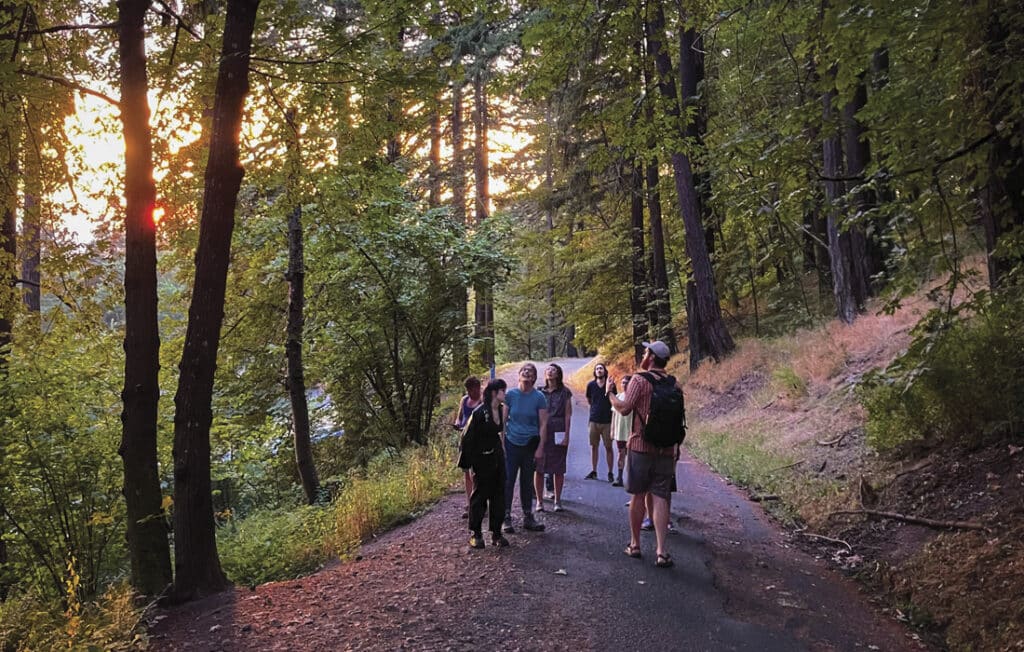
Join Bob Sallinger, Mike Houck and Jim Labbe on one of our spring Wild in the City Trips. Our morning or half-day paddles, walks and bike rides get you out and about our region's greenspaces and waterways. View trips and register.